Sunday, October 2, 2011

My East Cleveland Story

My Story of Growing Up In East Cleveland

My Family

The first thing to ask about my life in East Cleveland is how I got there in the first place.  Since I was born there, we have to consider the reasons my parents chose East Cleveland as the place to live and raise a family.  Those reasons may be similar to those of most families in East Cleveland at that time.  In 1920, when dad was six years old, his family moved to Collinwood.  The reason for that move was that my grandfather, Herman Dreifort, worked for General Electric, which had just opened its new lamp facility on E 152nd Street near Five Points.  The home in Collinwood allowed grandpa to walk to work every day from 1920 until he retired in 1954.  As a result my dad, Carl Dreifort, lived in Collinwood and graduated from Collinwood High School in 1932.  The country was in the middle of the Great Depression and it was difficult to find work, especially for recent high school graduates.  Dad did whatever he could to help support the family in those days.  By 1936 he had found a job at National Acme Company located at E 131 and Coit.  That was also the year that he met my mother, whom he married in 1938.  Because there was still a depression going on, mom and dad moved to a small apartment on Hayden Avenue just on the Collinwood side of the border with East Cleveland.

By 1940 mom and dad needed to look for a bigger place to live, because I was expected to arrive in September of that year.  As it turned out, I fooled them and arrived a month earlier than expected.  Not the first time I caused them problems by doing the unexpected.  In any case, they had to find a place to live and raise their new family.  I’m sure they asked the same questions that home buyers ask today such as:  How much can we afford?  How close to work can I be?  What are the neighborhood amenities?  Is the school system good?

East Cleveland was a logical choice for their house hunting.  It is next door to the community with which they were familiar (Collinwood).  The city had a good reputation for its community resources such as schools, parks, and shopping.  There was also a large supply of available homes that they might be able to afford.  The next decision concerned whether to rent or buy.  Dad came from a tradition of home ownership.  Therefore the main question was how to find a home, which they could afford to buy.  They decided that they should buy a two family home so that the rent from one suite would help them pay the mortgage, taxes and other expense related to home ownership.  They found the home of my childhood at 1719 – 1721 Shaw Avenue on the corner of Shaw and Plymouth Place. 

Our house on Shaw Avenue was the type of house that was built all over the Cleveland area right after World War I.  That was a period in which much of East Cleveland was developed.  The house had two suites, one up and one down.  Each suite had five rooms and a bath. As was true of many East Cleveland two family homes, it had an unfinished attic with two large rooms.  In most houses that space was just used for storage.  Dad decided to convert that attic to a third living space so that we could live on the third floor and rent out the first and second floor suites.  Since East Cleveland zoning was very strict about such conversions, Dad had to present his plans to City Hall and obtain a rooming house permit before making the renovations. 

It has been a tradition for Dreifort men to be very handy and self reliant in many areas including home maintenance. Dad often told me that we couldn’t afford to live in our house if he didn’t do everything himself.  Thanks to him I was able to learn many of those skills too.  With the help of his father, brothers, uncles and other family members, he planned and constructed the third floor renovation.  It consisted of building a dormer, which almost doubled the area of floor space.  They added plumbing, which made it possible to have a full kitchen and bathroom.  The result was a very comfortable two bedroom suite, which met all the zoning and other code requirements of the City of East Cleveland.  We moved into that suite when I was born and stayed there until my sister was born in 1944.  At that time we moved to the first floor and never had a problem finding good tenants for the third floor suite.  As a matter of fact my new wife and I lived there briefly in 1962 and 1963 before moving to Chicago (More about that later). 
Dad's Homes and Work 1936 to 1946

I’m not sure whether our family would have been considered middle class or lower middle class when we lived in East Cleveland.  Dad had a factory job in the maintenance department of National Acme Company.  According to W2 forms that I have, his annual pay was $1,104.81 in 1936.  That rose to $2,173.78 by 1939.  That amount did not even reach the $2,500 limit for reporting your earnings to the IRS that year.  I don’t know how that compared with other East Cleveland homeowners at that time.    I never felt deprived.  I didn’t get everything I asked for; but what I did get always seemed to be adequate.  I never knew how much my dad made and never considered whether that was more or less than the other fathers made.  To me my friends and I seemed to be in the same economic class.  Perhaps our family would have been classified as blue collar based upon Dad’s job and income level. 
No category would completely describe us unless the modifier “upwardly mobile” were added.  Dad was not able to go to college due to his need to work and support his family during the depression.  By 1940 the country was still in an economic depression and he had the best job he could find.  That job provided enough for him to buy a house and support his family in a fine community.  Dad’s younger brother, Donald, was able to earn a degree in engineering from Case Institute of Technology.  Grandma got a secretarial job at White Motor Company to help put him through college.  As the oldest son and first to be married, Dad had to follow in Grandpa’s footsteps.  That meant finding the best possible job and advancing by acquiring new skills through work experience.  Grandpa had done that at General Electric where he started out as an unskilled laborer and became a skilled tool and die maker.  Most successful companies at that time realized the need to invest in their employees by training and developing the necessary skills to meet the needs of the organization.  This required an employee with the ability and ambition necessary to advance by learning those new skills.  The result was good for the employee as well as the company.

Dad’s job at National Acme had an influence on our decision to live in East Cleveland.  Like his father Dad was able to walk from home to work and back, a distance of 1.5 to 2 miles each way, depending on the route.  It was not unusual for people to walk that far to work in those days.  Another option available was public transportation.  The main streetcar and bus line through East Cleveland was along Euclid Avenue.  When we first lived on Shaw Avenue, the streetcar line was still running.  It was later replaced by buses.  There was a major public transit hub at Windermere and Euclid.  Originally it was the streetcar barns for the Cleveland Railway Company later known as Cleveland Transit System (CTS).  From anyplace in East Cleveland you could easily and quickly get to anywhere in the region by public transit.  East of Windermere and Euclid the streetcars and busses traveled as far as the City of Euclid.  That provided access to the industrial area between Euclid Avenue and the Nickel Plate Railroad.  That included the area from E. 152nd Street to Ivanhoe where General Electric, Murray Ohio, Clark Controller, and other factories provided employment.  Farther east was the area around London Road and Euclid Avenue, which included Parker Appliance, Anchor Rubber and other factories.  Still farther east was Thompson Products TAPCO plant later known as TRW, Graphite Bronze and Eaton.  For anyone working downtown or points in between, public transportation provided easy access from East Cleveland.  There were also bus lines providing access to the area on the hill traveling on Noble Road and Taylor Road.  A major cross-town line cut through East Cleveland on Superior Avenue between Glenville and Cleveland Heights and points south.

With all the discussion of transportation, you might ask, what about automobiles?  Well, in the first place, they were an expense.  When you are making just enough to feed and house your family, you think twice before incurring other expense.  The Dreifort family had a history of owning automobiles.  Grandpa had a Model T Ford, which he probably didn’t use much.  Remember, he also walked to and from work.  By 1929, when my dad was 15 years old, Grandpa decided he needed a new car.  He bought a new Chandler, which was made in the nearby factory later occupied by Parker Appliance and currently used by The Cleveland Clinic.  That was a beautiful car, which he kept until 1954.  1929 was the year that Chandler went out of business due to the depression.  It was a great car and one of the last made in Cleveland.  When grandpa bought the Chandler, he kept the Model T, which became the car used by my dad and his brothers through the 1930s.  Dad did own a 1940 Chevrolet briefly, but he did not keep it long because of wartime restrictions. 

My First Years In East Cleveland

 When we moved to Shaw Avenue, World War II had already started in Europe.  The American economy was starting to revive due to war work.  Even so the depression did not actually end until the post war recovery of the late 1940s.  When the US entered the war Dad was 27 years old with a pre Pearl Harbor child (me) and employed in essential war work.  Those were the exact qualifications for being exempted from the military draft.  He often said that he should have made my middle name “Weatherstrip”, because I kept him out of the draft.  His two brothers, Donald and Ralph were younger than Dad and both served in uniform throughout the war.  Donald, who had a degree in civil engineering from Case, was in the Corps of Engineers in the China, Burma, India Theater.  He worked on the Lido Road.  Ralph served on a Navy destroyer in the Caribbean.  That was important duty due to the presence of German submarines in that area. 

I don’t have many memories from our first four years in East Cleveland (1940 – 1944).  That was the time that we lived on the third floor.  Dad was working at National Acme, a lot of the time on the night shift.  I do remember sitting with my mother, sometimes on her lap, while we listened to Bing Crosby on the radio.  His theme song, “When the  Blue of the Night Meets the Gold of the Day”, was one of my earliest memories.  I was an avid listener to all the popular music even as a small child.  Mom says that I often stood in front of the radio and record player bouncing with the music.  Some of my favorites were: Spike Jones playing “Der Fuhrer’s Face”, Pistol Packin’ Mama, and Chattanooga Choo Choo.  That early interest in music has stayed with me all my life.

Click on these links for some examples.

Old Time Radio Shows 
I have several mental pictures of living on the third floor.  I think I can remember one of my first Christmas trees.  That could have been as early as 1941 when I was about 1 ½ years old.  I remember a birthday party, when I was three or four.  There was also a time when my grandmother on Mom’s side came back from a trip to Florida and brought me a tiny catcher’s mitt, which I still have today.  I also remember the day that somebody came to take our 1940 Chevrolet. I asked Dad why and he told me he couldn’t get gasoline and tires for it anymore.  I later learned that we had been able to take a trip to Canada to visit my Mom’s relatives before selling the car.  That was at the time of gasoline rationing and Dad was able to make that long trip by installing an extra gas tank in the trunk and saving up his rationed gasoline.
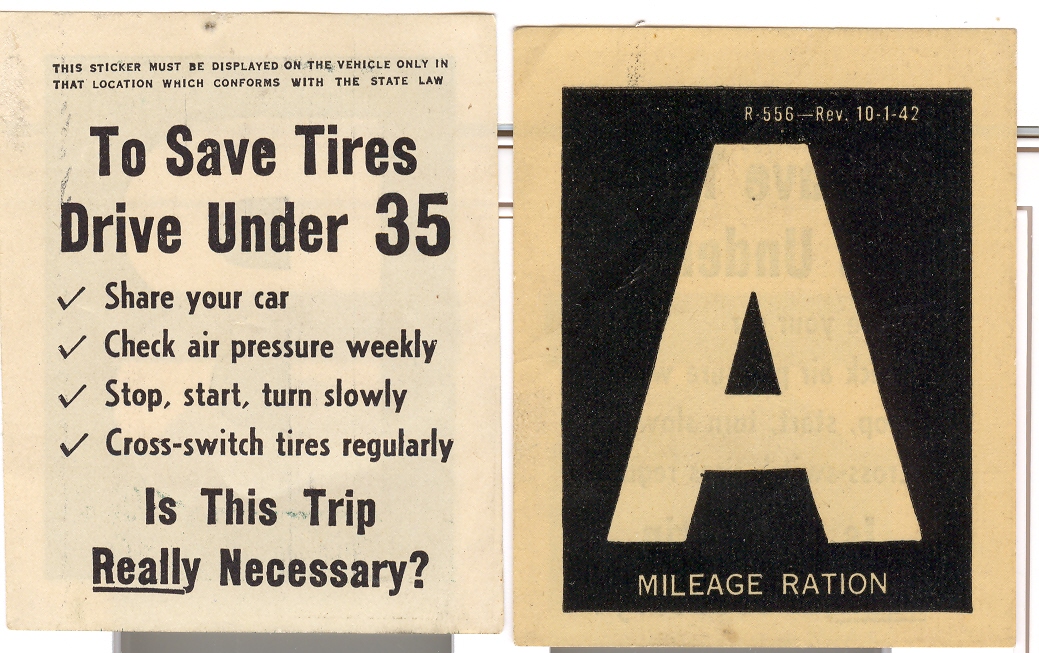

Gasoline Ration Sticker

Other things I remember about life in East Cleveland during the war include the rationing of food.  I can remember going with Mom to obtain ration stamps and tokens.  She had to get them at Prospect School.  These stamps and tokens were needed to buy certain food such as meat and sugar.  I liked the tokens best.  They were about the size of a dime and some were red and some were blue.


Wartime Travel Permit 1943

I also remember saving metal and grease for the war effort.  We would empty all of our tin cans, take off both ends and step on them to flatten them out.  The ends went inside the flattened can.  That and other metal was picked up by the City in a special truck.  I remember seeing one of our neighbor men working on one of those scrap drive trucks.  When I asked what they were doing, I was told that they were collecting things for the war.  We also saved cooking grease.  We took it to a local mom and pop grocery on Hayden Avenue.  I remember that the owner’s last name was Scher.    Mr. Scher always let me take a cookie from one of the cookie bins.  Needless to say, I always liked going there.  Another use for cooking grease was in making soap.  We sometimes took our grease to my Great Aunt Ethel Dreifort, who made soap and gave us some from time to time.  As I have said before, I never felt deprived as a child.  However, I do remember asking for some things and getting the answer that we can’t get that because there is a war going on.  I guess that seemed to be a reasonable answer at the time. 
My War Ration Book

1945 was a significant year for me.  I had my fifth birthday that year on August 8.  Another thing that happened around my birthday was cause for great celebration.  One day in August we were out in the front yard and I noticed that all the car drivers were blowing their horns and several people stopped to talk to Dad.  Everyone seemed very happy.  I asked Dad what all the excitement was about.  He told me everyone was happy, because the war was over.  That day was Wednesday, August 15, 1945, VJ Day.  To this day I can see that scene in my mind as if it were a movie clip. 


Another event, which made 1945 a special year in my life, was my first day at school.  That September Mom took me to Prospect School, where I enrolled in the afternoon session of kindergarten.  That was my first experience with a group of children with many of whom I was to share the next 13 years of school.  Our teacher was Mrs. Lowry and the classroom was on the first floor overlooking the Euclid Avenue playground.  All I remember about that experience is sitting around in a semicircle and listening to our teacher.  I’m not sure what I was supposed to learn in kindergarten.  The most important life lessons I think I learned included the following: 1. you need permission to go to the bathroom, 2. don’t wait until the last minute to ask.  Most importantly I learned to be self reliant.  After that first day, I walked to and from school by myself.  Even though it was only one block, it involved crossing Euclid Avenue and Shaw Avenue.

East Cleveland Police Officer Jack Baker

Another important event of 1945 was meeting a man, who would be a part of my life for all my years at Prospect.  That man was Officer Jack Baker of the East Cleveland Police Department.  Jack was the school crossing guard at Shaw and Euclid and he helped me and other children safely across that busy intersection for all of those seven years.  Jack always seemed old and fatherly to me.  I’m not sure how old he actually was at that time, but he worked at that intersection until he retired on January 1, 1959.  I have his autograph, which I obtained when I graduated from Prospect in 1952.


 Copyright 2011 Robert C. Dreifort all rights reserved

Monday, September 26, 2011

Government, Business, Neighborhoods and Schools

East Cleveland History


East Cleveland Government

From 1918 until 1985, East Cleveland was governed by the City Manager form of government.  This was an idea developed by the progressive movement, which was very influential at the time East Cleveland adopted its first charter.  Citizens voted for members of a five person City Commission, who in turn selected a professional city manager to run the city.  There was also an elected judge of the East Cleveland Municipal Court.  The progressives believed that a city manager would provide better management by separating the provision of city services from the factionalism and political infighting found in a Mayor and Council form of government.  The theory was that there is no Democrat or Republican way to collect garbage.  In the case of East Cleveland that theory seemed to work well during the time I lived there. 

The East Cleveland school system was governed by a five member Board of Education.  The Board hired a professional Superintendent of Schools, who managed the entire system of six elementary schools, a junior high school and a high school.  Each school was managed by a principal, who in turn selected and managed a team of teachers and support staff. 

All the municipal and school district officials were elected on a non partisan basis.  These officials usually had other jobs in addition to their public one, because the public positions involved little or no financial compensation.  They ran low key election campaigns and were often unopposed.  There was a tradition of community service, which meant that public officials served the community without a particular interest in their own political careers.  They were not professional politicians.  For the most part they were local businessmen or normal citizens, who took the jobs as a civic duty.  For many years this system resulted in a well run City and School District without a hint of corruption.  There were no public employee unions for municipal or school employees.  Those employees had a strong civil service system to ensure fair working conditions.  That system seemed to work well.  I don’t remember any incident of public employee dissatisfaction, when I lived in East Cleveland. 

East Cleveland Business Community

There were close links among the East Cleveland business community, the citizens and the government.  East Cleveland citizens were highly dependent upon local merchants for the daily needs of their families.  Those merchants were equally dependent upon the citizens for their livelihoods.  Both the citizens and the merchants needed good government and schools.  Merchants were some of the best known people in the neighborhood and often took an interest in serving their community. They served in appointed or elected community jobs such as Library Board, Selective Service Board, PTA groups, etc.  They also organized the annual East Cleveland Community Picnic at Euclid Beach Park.  Their direct contact with customers made them extremely visible to the community.    They also appeared in patron advertisements in School Yearbooks, football programs and in the weekly community newspaper, The East Cleveland Leader.   Some examples of businesses, which provided leadership, included: Nelson Jewelry, Don Fisher Furnaces, Tobin Drug, Stonebraker Drug, Ricks Radio and Records, and Windermere Storage.  Some businesses served areas outside of East Cleveland as well as the immediate neighborhood.  Many served more than one neighborhood and others were “Mom and Pop” stores that served a very local population.  Two examples of the latter are Wards Delicatessen at Euclid and Strathmore and Pat Woods convenience store at Coit and Elm.  Tobin Drug had two stores, one at Euclid and Taylor and another at Euclid and Page.  All those businesses, large and small, contributed greatly to the East Cleveland community.

Neighborhoods and Schools

Even a small and compact community (3 sq. miles) like East Cleveland has a number of distinct neighborhoods.  In East Cleveland, those neighborhoods related to the elementary schools.  This is natural, because the number and location of schools was designed to allow children to walk to school.  There were no school buses and parents did not drive their children to elementary school.  Every afternoon at about 3:00 PM the streets of East Cleveland were full of children and teens going home from school.  Most were walking, but some rode bicycles.  It was necessary for some students at Kirk or Shaw to take a streetcar or bus to and from school.  Only a few Shaw High students found it necessary or possible to drive to and from school.  There were six elementary schools in East Cleveland: Prospect, Superior, Rozelle, Mayfair, Chambers, and Caledonia.  Here it should be pointed out that the Caledonia district included the area on the Hill.  The Caledonia neighborhood included a small part of the City of Cleveland Heights that was part of the East Cleveland School District.  Almost every student in East Cleveland went to Kirk Junior High School or Shaw High School starting in seventh grade. 
East Cleveland Elementary Schools and their neighborhoods

Children or teens who attended parochial schools were an exception to the above.  In East Cleveland,     that mostly meant attending Catholic schools.  The major Catholic school in both of my neighborhoods (Prospect and Caledonia) was Christ the King located on Noble Road between Euclid and Terrace.  A few of my friends from both neighborhoods attended Christ the King through eighth grade.  Some of them went on to a Catholic high school and others transferred to Kirk.  There was also a Catholic grade school at St. Philomena.  Some of the Catholic High Schools attended by East Cleveland students included: Regina, Ursuline, and Beaumont for girls and St. Joseph, Cathedral Latin, St. Ignatius and Benedictine for boys.

Over the years, I lived in two different neighborhoods.  From 1940 until 1952 I lived in the Prospect neighborhood.  From 1952 until 1962 I lived in the Caledonia neighborhood.  Although most of the neighborhoods were very similar to each other, the Caledonia neighborhood was somewhat different.  In many ways Caledonia was more similar to the adjacent areas of Cleveland Heights than to the rest of East Cleveland.  In spite of that difference, I think those who lived there tended to identify more with East Cleveland because we went to the East Cleveland Schools.  I know I did. 

Moving from our elementary school to Kirk Junior High School was a major rite of passage.  Suddenly our social network included people from all six East Cleveland neighborhoods.  We adapted quickly to this opportunity and developed new relationships that usually lasted for the six years we were at Kirk and Shaw High School.  In other words, our formative years from kindergarten to sixth grade were spent with a fairly constant group of children from our neighborhood.  We then spent six more years with a fairly constant group of peers from the entire City of East Cleveland.  There was some change in the actual people in our schools over those 13 years.  Some people moved away while others moved in.  However, you can tell how stable the community was during the 1940s and 50s by looking at the class pictures.  Each year many of the same faces appear.  Several children, who I first met in kindergarten, were in my graduating class from Shaw High School.  

Although each neighborhood was built around an elementary school, it also had certain other community resources upon which it depended.  Those included neighborhood shopping areas, parks, churches, and sometimes employment.  Some of these resources served more than one neighborhood.  An example is Shaw Stadium and the adjacent park.  That facility was in the Chambers neighborhood, but those of us in the Prospect neighborhood considered it ours as well.  Another example was Forest Hill Park which served all of East Cleveland and Cleveland Heights as well.  All neighborhoods had access to the East Cleveland Public Library or one of its two branches. 

Shopping was found mostly along Euclid Avenue and Hayden Avenue.  The primary shopping areas were at Taylor and Euclid, Lee and Euclid, Superior and Euclid and Shaw and Hayden.  The Caledonia neighborhood shopped mostly at Noble and Nela View, but there was also a small shopping area at Taylor and Nela View.  There were no large shopping centers or big box stores.  Most of the daily essentials were available within walking distance.  If something wasn’t available locally, you took a streetcar or bus downtown or to E 105 St. and Euclid.  Those were the major shopping centers for East Cleveland.  Each neighborhood had a movie house it called its own.  There were three of them: Shaw Hayden, Windermere and Euclid.  Those in the Caledonia neighborhood usually went to the Center Mayfield.  If you couldn’t find what you wanted at those local theaters, you went downtown to one of the many first run theaters.

Now that I have provided an overview of East Cleveland institutions and history, the rest of this blog will concentrate on my personal experiences and memories or how it was to grow up in that community.

Copyright 2011 by Robert C. Dreifort  all rights reserved

Sunday, September 18, 2011

Introduction to East Cleveland

East Cleveland History

Introduction
A study of the history of East Cleveland might start by asking, why it exists in the first place and what are the basic geological, geographical, political and social factors that made it what it was and is.  An argument could be made that East Cleveland had no clear identity of its own.  Each part of East Cleveland is like the community it borders.  On the North it borders the Collinwood section of Cleveland.  On the West it is adjacent to The Glenville section as well as University Circle and Little Italy.  Finally, on the South and East is Cleveland Heights.  In many ways the socio-economic groups, housing etc. in East Cleveland were quite similar to those in adjacent communities.  The Italians of the Western portion of East Cleveland could rightfully consider themselves a part of Little Italy.  Similarly the mostly blue collar ethnic groups in East Cleveland often moved there because of the availability of good jobs in the many industries that Collinwood and East Cleveland shared.  If you didn’t know where the boundary line was, you would not know if you were in East Cleveland or one of the communities bordering it.

Although it could be argued that East Cleveland had no identity of its own, I would argue just the opposite.  As it worked out East Cleveland was a unique mixture of all the elements represented in those adjacent communities.  By 1940 the community was fully developed with a stable population of about 40,000 people including a variety of ethnic groups, blue collar workers, professionals, small business owners and employees, and workers in various University Circle institutions.  This diverse group was the basis for quite a unique community.  Many factors contributed to East Cleveland’s unique identity.  Among those factors were a strong local government, good schools, and a strong local business community.  Those factors, along with the small and compact size of the City resulted in a community in which families could work, play, learn and grow.  I will analyze each of these factors in more detail in following postings.

Geology
Geology had an important influence on East Cleveland as well.  All of Northeast Ohio was created by the receding ice cap that created the Great Lakes and the area in which East Clevelanders lived.  The glacier that formed Lake Erie receded in stages leaving definite contours in the land.  East Cleveland lies right on top of an important geological boundary.  Euclid Avenue lies on a glacial beach and Terrace Road is at the bottom of a hill, which some consider the beginning of the foothills of the Appalachian Mountains.  That geological feature also resulted in a separate and distinct portion of the City know as “the hill” or the Heights.  The Hill is actually a ridge that is crossed by several creeks, brooks and other natural waterways.  Those waterways also became the basis for the roads built to travel between lower East Cleveland and upper East Cleveland.  Most of those streets were built on top of large culverts through which the creeks and brooks flow.  The engineering problems encountered in building those roads were complex.  The Roads in East Cleveland that connect to the Heights are Noble, Taylor, Stanwood, Lee, Forest Hill Blvd., and Superior. Those streets follow the paths of waterways, which were placed in underground culverts.   However, as many East Cleveland kids discovered, some sections of those creeks were and are to this day open in hidden ravines behind developed land.   
 Ohio geological features showing Euclid Avenue geological beach and Appalachian Foothills

East Cleveland showing division between Euclid Avenue geological beach and "The Hill"
Some man made features, which resulted from geological factors, also had a great influence on the history and character of East Cleveland.  An important example is the two railroads, which cut through the City. Railroads usually follow paths of least resistance.  As a result they passed through the center of East Cleveland.  Those railroads, the New York Central and the Nickel Plate Road entered East Cleveland from the West in a combined road bed.  They proceeded northeast to Superior Avenue, where the New York Central turned north roughly following the western border of East Cleveland.  The Nickel Plate continued northeast roughly one block North of Euclid Avenue.  The flow of traffic within East Cleveland was influenced by these railroads and the bridges that they went over. Unlike the City of Lakewood, Cleveland’s nearest western suburb, the railroads in East Cleveland had no grade crossings.  This made East Cleveland a safer place for drivers and pedestrians.  Both of these railroads were headed to the industrial areas North of East Cleveland.  Those areas provided many jobs for residents of East Cleveland and the residents of Collinwood, who also felt the influence of the railroads. ( In the case of Collinwood that influence is represented in the name of the Collinwood High School athletic teams, “The Railroaders”.)  One industry, whose location was influenced by the railroads was General Electric.  That Company provided a lot of employment for East Clevelanders both in the industrial area of Collinwood on the Border with East Cleveland as well as the Research Facility at Nela Park located in East Cleveland at the top of the hill near the eastern border.  Many families with Children in Caledonia Elementary School were there because someone in the family was employed at Nela Park. 

Geography
Geography had a great influence on East Cleveland.  It is essentially what was left of the East Cleveland Township after Cleveland ended a series of annexations early in the 20th Century.  If the pattern of annexation had been similar to that of the City of Columbus, Ohio, most of the suburbs of Cleveland would now be part of the City of Cleveland.  As it turned out, East Cleveland is surrounded by Cleveland and Cleveland Heights.    A major factor allowing East Cleveland and other inner ring suburbs to resist annexation to Cleveland was the adoption of municipal home rule by the State of Ohio in 1912.  That change to Ohio’s constitution allowed communities to incorporate as a village or a city rather than accept annexation to Cleveland. The effects of that law were both good and bad depending upon your perspective.  First it ended the geographic expansion of Cleveland while permitting many new communities such as East Cleveland to develop.  The City of East Cleveland and other new suburban communities were, perhaps, a good outcome for those living there at the time.  There were advantages to living in a small community where you knew your neighbors, businessmen and officials, and making it easier to meet the needs and desires of the citizens.  However, East Cleveland is now dealing with the downside of suburban proliferation in its efforts to develop a more regional approach to government and the provision of public services.  Inner ring suburbs like East Cleveland were the first to feel the downside of the proliferation of municipalities in Cuyahoga County.  Many of those communities’ current problems can be traced to a small tax base and the expense of meeting the complex needs of an inner city community. 

During the period in which I lived there, the City of East Cleveland did not face many of the current problems.  It had a good tax base due to the good mix of residential and industrial land use.  The people living there were able to find work during World War II and the post war prosperity of the late 1940s and the 1950s.  The housing stock was relatively young and in sound condition.  The many small businesses were able to meet most of the neighborhood shopping needs prior to the era of large suburban shopping centers. All of these factors resulted in good schools and a stable community. 

Copyright  2011 Robert C. Dreifort  All rights reserved

Sunday, September 11, 2011

Introduction to Robert Dreifort


Since graduating from  Shaw High School in 1958, I have educated myself, married a wonderful wife, raised two great kids, and pursued happiness through a number of interesting hobbies, all of which was supported by a long and checkered career in government, health care and higher education mostly in the Cleveland area. 

Shaw High School
I met my wife, Jean, while we were undergraduates at Western Reserve University.  I have my AB in History and Political Science and Jean earned a BS in Psychology.  Jean went on to get an MSLS at Western Reserve and I have a Master of Public administration Degree from Cleveland State. 

Shaw High School
The first twenty years of my working life involved a number of positions in government at the federal, municipal and county levels.  I was a field representative for the federal Urban Renewal Administration, then a research assistant for the Citizens League of Greater Cleveland, followed by service as an Urban Planner for the Cuyahoga County Regional Planning Commission, and a Budget and Management Analyst in the Mayor's Office for the City of Cleveland.  That experience included service to two Cleveland Mayors, Stokes and Perk.  My last job in government was as the Operations Director for the Cuyahoga County Mental Health Board.  The last twenty years of my working life were almost equally divided between service as a Health Care Administrator at the Cleveland Clinic Foundation (CCF) and as a Department Administrator at Case Western Reserve University (CWRU).  I retired from CWRU in 2004 and have been pursuing my hobbies full time since then.

One of my hobbies is Big Band Music as the leader of the Smart Set Band.  Click on this link for more information about that:


Smart Set Band

 Another of those hobbies is the study of Cleveland area  history with an emphasis on the History of East Cleveland.  My youth spent in East Cleveland was a wonderful time.  And I have been spending a lot of my retirement  trying to recapture the spirit of East Cleveland during the time that I lived there from 1940 to 1963.  As I write a section of my memoirs, I will post it to this blog.  

If anyone wants to comment on my memoirs or has some memories they wish to share, please post a comment.  

For more Dreifort family history go to www.dreifort.com

 Some East Cleveland Images

Here are some images of East Cleveland that should bring back some memories.  The first is the old Prospect School before the addition was built to the right of this picture.  When I started kindergarten there in 1945, the School included this building and the addition.  There were two playgrounds, one between the new building and Euclid Avenue and another to the left of this building.  The playground to the  left was behind a wooden barracks style building, which faced Shaw Avenue and was Shaw High School's band room.  Also on that playground was a wooden shed known as the "paper house".  That was used during the wartime paper drives.  I will later post my class pictures, which were taken on the stairs of the building in this picture.

Prospect School
Shaw High School

Above is a picture of Shaw High School taken in 1933.  This is looking South on Shaw Avenue.  My home was on the corner of Shaw and Plymouth just behind where the photographer is standing.  This was my view as I went to school from 1945 until we moved to Nela View in 1953.  More about that later.  Just outside of this picture on the left was the Abel Funeral Home.  On the right was a  gas station and Karl Brown's Colonial Inn, a fine restaurant. 


Copyright  2011  Robert C. Dreifort  All rights reserved