Wednesday, August 1, 2012

Plymouth Place


A Wonderful Neighborhood

My first East Cleveland neighborhood was centered on Plymouth Place.  We lived on the corner of Shaw Avenue and Plymouth Place.  My friends lived mostly on Plymouth, although a few also lived on Shaw, Taylor Road and other nearby streets.  Most of our activities occurred on Plymouth Place and in the large field at the end of that street.  Plymouth was a dead end street with only nine two family houses on each side of the street.  At the end of the street was a large field stretching from the railroad at the North end almost to Euclid Avenue on the South end.  There were two houses between my house and the railroad on Shaw.  All the houses on the North side of Plymouth backed up to railroad property.  The houses on the South side of Plymouth backed up to the large back yards of houses on Welton Drive.   The far side of the field was bounded by the back yards of houses on Taylor Road.  A dirt path through the field provided access to Taylor Road and the shopping area at Taylor and Euclid.  Plymouth Place, the railroad tracks, the field, and the shopping area at Taylor and Euclid provided an ideal neighborhood in which to grow up.

My Plymouth Place Neighborhood 1940 - 1953


As might be expected, my early memories of the neighborhood are limited to my house and the area close to it.  That includes my front and back yards and some of the close neighbors’ houses.  My friends at that stage included some of the neighbor kids, who came to my birthday parties and stopped by when I was outside with my parents.  I didn’t go very far on my own until I was about four years old.  I can remember a specific occasion when I wandered as far as the field at the end of the street.  I was clearly alone at the time.  That trip expanded my horizon and gave me an important life lesson.

Robert Dreifort and Friend May 1942 - A view down Plymouth Place

a a
The patriarch of the Morris family, who lived in the last house on the street, was known as Grandpa Morris.  He lived there with his married son and grandchildren.  At that time he had a victory garden in a large section of the field next to his house.  I’m not sure who owned the land in the field.  All of us in the neighborhood used it as a sort of common property.  The houses that backed up to the railroad embankment had a strip of land between their property and the embankment, which some used for a garden.  No one seemed to mind this informal share cropping in an urban setting.  Grandpa Morris kept his garden for several years.  I guess old age eventually forced him to give it up and nobody else ever planted one there.  

On this occasion I walked to the end of the street and Grandpa Morris was working in his garden.  He noticed me on the path and asked if I would like to see his garden.  It must have been midsummer, because there was a lot of stuff growing there.  I don’t think I ever saw a garden that close before.  Then an amazing thing happened.  Grandpa Morris reached down, grabbed a handful of leaves and pulled.  Imagine my surprise when a bunch of large red radishes appeared in his hand.  He told me to take them to my mother, which I quickly did.  From that day forward I had an appreciation of where some of our food comes from.  That probably helps explain why to this day I plant a vegetable garden each year.  I love growing things you can eat as well as things that look nice.

As I grew older and bolder the field became an important place in my life.  It was big enough that it had several distinct sections.  Cutting through the middle of the field was a path that was used by children and adults to travel from Plymouth to Taylor and on to the shopping area at Taylor and Euclid.  The path was just dirt that had been packed down by many feet and bicycle tires.  Just south of the path was a section that we used as a baseball field in summer and a football field in fall.  The sports field had been developed over time by generations of neighborhood kids.  The baseball area had a dirt infield and a homemade backstop.  When kids became old enough to play ball, they also assumed the responsibility for maintaining the field.  That included cutting the grass and fixing the backstop.  
  

Robert Dreifort and Grandfather on Ball Field - 1949

North of the path was mostly open field with two or three clumps of trees.  This area was used for hiking, playing war or cowboys and Indians or just hiding out.  This area and the area south of the ball field were used by successive generations of kids to build forts.  Some of these became quite elaborate.  Many of the kids were quite handy with various tools and were able to get building material from home.  A common building material was railroad ties, which were sometimes found on the embankment.  One of our more imaginative forts was a small shed that we built over a utility manhole cover.  We covered the manhole with a rug and would escape down the manhole, when we wanted to disappear.  That ended soon after one of our parents got wind of it.  

It wasn’t long before we extended our explorations to the railroad embankment.  This led to adventures on the tracks and bridges as well.  In addition to the strip of land between the rear of Plymouth houses and the embankment, there was a large section of land on top of the embankment.  The reason that embankment was over 100 feet wide on average was that the Railroad at one time thought they would need a siding there.  The embankment stretched from Shaw to Coit Road and was quite wide the whole way.  It included clumps of trees and bushes, which were ideal for hiding and playing.   

The Shaw Avenue Bridge

There were bridges for the trains to cross over Shaw Avenue and Coit Road.  Our adventures soon took us over those bridges.  Across the Shaw Bridge was a siding for the East Cleveland Lumber company.  There was often a boxcar parked there waiting to be unloaded.  The boxcar and the lumber yard were great places to play war or cowboys and Indians.  Across the Coit Bridge was the Goff Kirby concrete company.  This included trestles at railroad level from which railroad cars dumped piles of sand and stones used in making concrete.  You can imagine what fun it was to jump from the trestle into those piles.  

Across the railroad from Plymouth was a large open area used by Carmen Bill’s Golf Driving Range.  I would sometimes watch the golfers practice there, although I never took up the game.  The area was also used by Shaw High School as a football practice field.  Kids from our neighborhood often watched the team practice.  In the winter the golf range was vacant and became another great place to play.  Each Christmas they would sell trees there.  After I moved, the Golf Range was turned into a City of East Cleveland skating rink.

Janet Dreifort on Plymouth Place 1950

The Plymouth neighborhood had other venues for childhood play.  Believe it or not, one of them was the street.  Plymouth was a dead end street.  It did not get a lot of traffic and very few people parked cars in the street.  I’m pretty sure that many people didn’t own cars and those who did used the driveways or garages.  We often played ball in the street, if we didn’t feel like going down to the field. That included baseball and touch football or just games of catch.  Another popular game was “kick the can”.  We would put a can in the middle of the street and the one who was “it” covered his or her eyes and counted to ten or twenty.  The length of the count and other things were somewhat flexible.  We often made up rules as we went along.  While “it” was counting, all the others ran and hid.  The object was for each kid to try to kick the can before being seen by “it”.  If you were seen trying to kick the can before actually kicking it, you were “it”.  That was just one variation of many hiding and chasing games we played.  We also played in the yards.  Running from yard to yard was yet another great way to play hide and seek or cowboys and Indians.  

Robert Dreifort playing ball in the street 1950


Another favorite hangout was the second floor of one of our garages.  We were able to set up the single room above a two car garage as a sort of club house.  We would spend hours hanging out playing cards or plotting mayhem of one sort or another.  Most of our plots were fantasy and never materialized.  We always imagined that someone would be after us, so we devised elaborate escape routes, many of which involved going out the second floor windows to the yard below and through the back yards of the Welton Drive houses.  We became adept at scaling fences and knowing the openings, which we could get through. We assumed that we knew the neighborhood well enough that nobody could catch us if we didn’t want to be caught.  Although we practiced those maneuvers many times, I don’t believe any of us ever actually had to use them. 

Another venue for kids play in our neighborhood was inside the houses.  Some of the kids’ houses had finished attics above the second floor suite.  Remember these were all two family houses.  These were great places to hang out or to have parties.  That included birthday and Halloween parties as well as just getting together to listen to records and dance.  In my house, I fixed up the basement for these parties.  The basement workshops of our fathers were also handy for building our projects such as soapbox cars and repairing our bicycles.  The front porches of our houses were also great places to gather.  We would put two lawn chairs against the railing and play Tom Corbett Space Cadet.  Each kid would take the part of one of the characters on that TV show.  We also had endless games of cards and Sorry on one of the Kids’ porches.

Party in My Basement - 1951
Row 1 Ken Barton, John Murphy, Ricky Probst, Bob Dreifort, Midge Grahling; Row 2 Margaret Heron, Margie O'Hair, Mary Hartley, Mom, Bob Barbey; Row 3 Earl Pratt, Virginia Richter, Janet Dreifort, Bruce Macmillan, Dick Barbey


As we got older, our activities took us farther away from Plymouth.  It was an easy walk to the city park just north of the railroad at Shaw and Allegheny.  That park included the Shaw High football stadium, tennis and basketball courts, a baseball field, a large playground, a concession stand and a first class swimming pool.  Kids often went alone or in groups to the park.  A little farther away was Forest Hill Park.  The main reason to go there was the sledding hill on the area that had been John D. Rockefeller’s front lawn.  

Another area that we learned about from our older peers was a place called Owl’s Nest.  That was a private estate South of Terrace Road and behind Shaw High School.  The entrance was a continuation of Shaw Avenue.  We discovered that an area behind the Owl’s Nest was a ravine, which was a section of a creek, which was open from Terrace Road on the north end to Northvale Road at the south end.  The ravine was deep and the creek had formed interesting patterns on the shale walls.  Once inside that ravine you felt as if you had left the city behind.  We would often walk the entire length of the ravine.  The creek had cut a path from the high end at Northvale to the low end at Terrace Road.  It emptied from and into culvert pipes at each end.  We would sometimes see how far we could go into those pipes.  Years later, after I moved to Nela View Road more than a mile south of the Owl’s Nest, I found that the kids up there had also discovered that ravine. 

It was a great neighborhood and a great life. Many of the things we did had established rules such as baseball and football.  Other things we learned from our peers, who were a little bit older than us and much of what we did, we just made up.  Yes we did some silly things back in the day.  I sometimes wonder how I survived my childhood.  Compared to the sheltered life of kids today, climbing down manholes, playing on the tracks and bridges, jumping off of trestles and playing chicken with locomotives, etc. seems a little dangerous.  However, most of us survived and did pretty well for ourselves.  Our lives were not planned or organized except as we organized them ourselves.  Most of the things we did occurred outside and we had a rich variety of places in which to use our imaginations.  Our parents told us to go out and play.  They knew roughly where we were and who we were with. We knew that we should be home when the streetlights came on.   What they didn’t know didn’t hurt them, or for the most part us, as it turns out. 

Monday, November 7, 2011

Prospect Elementary School Cont.

My Favorite Teacher

In September of 1950 I entered the fifth grade at Prospect Elementary School.  I had just celebrated my tenth birthday and was about to begin the best year of my career at Prospect.  It was then that I met Mrs. Hazel Cramer, our fifth grade teacher.  Mrs. Cramer’s classroom was in the old section of the school overlooking the Playground on the South side of the building.  This was the first time our class met in the old building.  Our Kindergarten through fourth grade classrooms had all been in the newest section of the school overlooking the Euclid Avenue playground.  Moving to the old building seemed to be a significant step in our maturation.  We were now closer to the seat of power (Mr. Preston and Miss Woodruff) and quite separated from the younger children.  I believe we even used a separate entrance. 

Most of us can identify one or more people, who had a great impact on our lives.  That person may be a friend or relative or some other adult, whom we look to for guidance and inspiration.  Often that person is a teacher.  I have had many teachers in my life.  Most of them had some influence on the person I have become.  However, very few of those teachers stand out from all the others.  Hazel Cramer was the teacher, who was first able to inspire me to grow and achieve.  The year I spent with her was a breakout year for me in many ways and not just in school.
 
As I said earlier, I spent the first five years of my school career just getting by.  I did as much work as necessary but no more.  I knew the stuff I was doing was important but I wasn’t really inspired by it.  I was also somewhat shy and introverted.  I think I was self conscious about the fact that I wore glasses and that my left eye turned in.  For that reason, I believe, I seldom volunteered or put myself out there.  I didn’t want to call attention to myself.  That all changed in the fifth grade.  A lot of that change I attribute to Hazel Cramer.

Hazel Cramer was a trained teacher, who probably knew all the latest thinking on educational theories and techniques.  However, I’m sure all my other teachers had been just as well trained.  If there was any one technique Mrs. Cramer used with me, I believe it was positive reinforcement.  The difference is that I don’t believe that was just a technique with her.  She was a very nice and caring person.  Without even realizing it, I found myself participating more in class.  I came out of my shell and lost many of my inhibitions.  I was able to do that because Mrs. Cramer gave me the support and encouragement I needed to achieve my potential.  I found myself wanting to do things to please her and as a result I was feeling better about myself.  In retrospect that awakening I experienced in the fifth grade may have been influenced by factors outside of my school life as well.  I had a wonderful group of peers in my neighborhood, which provided a comfortable environment in which to develop my interpersonal skills.  Some of my new sense of security and confidence may have been a result of normal maturation.  That being said, I believe my relationship with Mrs. Cramer in school that year was the major influence on my success in school and in life generally.  I will always remember her fondly.

For some reason my fifth grade class is the only group for which I do not have a class picture.  I think they may not have made class pictures that year.  I did correspond with Mrs. Cramer briefly after graduating from Prospect School.  The entry she made in my graduation autograph book is shown below along with a picture of Mrs. Cramer taken at her Cleveland Heights home in July, 1951.

Later in life I got to know Mrs. Cramer’s daughter, also named Hazel Cramer.  At that time both Hazel and I were attending Western Reserve University.  Hazel was studying French.  She went on to become a very successful Professor of French at State University of New York in Cortland.  I have recently corresponded with Hazel, who informs me that both of her parents have passed away.  I had hoped that her mother was still alive so I could tell her how important she was in my life.  Unfortunately I waited too long.  However I hope I was able to demonstrate my regard for her back in the day.  I am sure that she had similar influence on the lives of many students during her time at Prospect Elementary School.

Sixth Grade and Graduation from Prospect Elementary School

In September, 1951 I finally met Miss Woodruff, the authority figure, whom I dreaded for most of my career at Prospect.  As I wrote earlier, she was in charge of school discipline and ran the Safety Patrol.  Any minor infraction could result in the miscreant being “sent up to Woodie”.  She was also my sixth grade teacher.  I found her to be a very pleasant person, not anywhere near as fearsome as her reputation.  By that time I also had the self confidence to not be intimidated by her reputation.  She was always fair and helpful to me.  Having adopted a new attitude toward myself and school in the fifth grade, I think I was better prepared to succeed in the sixth grade.  I even served on the Safety Patrol.  That meant I could wear a badge while guarding various entrance doors and halls.  I even got to ring the school bell on several occasions.  I never got the prime assignment for a Safety, which was working the crossing at Shaw and Euclid along with Patrolman Jack Baker.  Miss Woodruff was an important influence on my life both as an unseen and distant disciplinary figure and a close up classroom teacher.
Prospect Elementary 6th Grade - Miss Woodruff

Note:  Miss Woodruff top row right
Robert Dreifort bottom row left

We had a second teacher in the sixth grade.  Her name was Mrs. Porter.  Mrs. Porter’s classroom was across the hall from Miss Woodruff’s room.  The class moved to Mrs. Porter’s room once a week or so for our music lesson.  For some reason Miss Woodruff did not teach music.  This was unusual, because all the teachers in the Kindergarten through fifth grade had a piano in the classroom and taught music as a regular part of the curriculum.  Moving from one classroom to another for music in the sixth grade did prepare us for the fact that we would be moving from class to class and teacher to teacher, when we moved on to Kirk and Shaw.   

In addition to the classroom music lessons, the East Cleveland School District employed an elementary school music instructor, who served all six elementary schools.  Her name was Marjorie Shields.  Miss Shields met with students in their classrooms and worked with large groups of students in the Auditorium on choral music.  She later moved up to Shaw High School where she directed the choral music program.   
Prospect students were also able to take instrumental music.  I think that happened in about the fifth grade.  The instrumental lessons were given in the Shaw High School band room located in the wooden barracks like building adjacent to our playground.  I briefly took trumpet lessons in that program.  Unfortunately, I didn’t have the interest or dedication to keep up with those lessons.  The next time I decided to take trumpet lessons was when I was 28 years old.  I have been playing trumpet and leading a community dance band ever since.  Perhaps the seed for my musical career was planted back in Prospect School.  The link below is to my dance band, the Smart Set. 


I graduated from Prospect Elementary School in June of 1952.  My experiences at Prospect prepared me well for the move to Kirk and Shaw as well as the entire life before me.   I had an autograph book at that time.  Some of the messages from Prospect staff and my fellow students are included below:


Friday, October 21, 2011

Prospect Elementary School

East Cleveland's Elementary Schools

There were six elementary schools in the City of East Cleveland, which explains the name of the regular column, which appeared in the East Cleveland Leader, “The Six Sixes”.  That column was written by Charles Cassil Reynard, a teacher of English, Latin and Math at Shaw high school.  He and his family were our neighbors, when my family moved to Nela View in 1952.  His son, David Reynard, was my best friend throughout Junior High and High School.  However, before I even met David, I attended the elementary school, which I knew best, Prospect Elementary School.  I’m sure the experiences my peers at Kirk and Shaw had at their East Cleveland elementary schools were quite similar to mine. 

Prospect Elementary School - The Building

Prospect School received its name from the street, which ran in front of it.  That street ran between Shaw High School and Prospect Elementary School.  Prospect Street was later named Shaw Avenue even though it was not a clear extension of the Shaw Avenue on the other side of Euclid Avenue.  There was a significant offset at Euclid Avenue.  Traffic wanting to continue North or South on Shaw Avenue needed to make a right turn and an immediate left turn at Euclid Avenue.  Pedestrians were not permitted to cross Euclid from the East side of Shaw.  The crosswalk and crossing guards were on the West side of Shaw Avenue.   The entire time that I lived in East Cleveland the street was named Shaw Avenue.  It should be noted that the street no longer exists after the demolition of Shaw High School early in the 21st Century.  There is no street between Euclid and Terrace at that point now.
Prospect Elementary Original Building

The Prospect school building, which I knew from 1945 until 1952, remained relatively unchanged until it 
was replaced by a new Prospect School in a different location late in the 20th Century.  The current Prospect School is located on Stanwood.  In 1945 Prospect School included several buildings, which were built at different times and interconnected with each other.  The original building was almost identical to the Superior and Mayfair elementary school buildings. Those were the first three elementary schools built in East Cleveland.  The three other elementary schools were built later.  Chambers and Rozelle, built during the 1930s, looked quite similar to each other.  Caledonia School was built last and looked different from all the others. 
Prospect School from Euclid Avenue circa 1941

As Prospect required additional space through the years, new buildings were attached to the old school.  Two of those buildings were built behind and to the west of the original school.  They included classrooms a boiler room and a gymnasium, which was also used as an auditorium.  The newest addition was on the North or Euclid Avenue side of the original school.  Most of these additions matched well with the original school.  The exception was the newest building on the Euclid Avenue side.  The levels on that building did not match exactly with the original school.  Therefore, you could not reach the old building from the new building on all floors.  For a little kid that was sometimes confusing.  However, once I figured it out I was quite proud of myself.  As I recall, my first years at Prospect were spent in classrooms located in the new building.  The fifth and sixth grade classrooms were in the old building. 

Prospect School Administration

Prospect was managed by a Principal whose name was Everett M. Preston.  Mr. Preston was a somewhat remote figure, sort of like the Wizard of Oz.    He was very mild mannered and friendly to the students.  Although most students had few opportunities to deal with him, it was clear that he was the ultimate authority.  It was his voice you usually heard on the PA system.  Mr. Preston managed a staff of approximately thirteen teachers, a school nurse and a custodian.  As far a I could tell, he did a fine job.
 
Day to day discipline at Prospect was delegated to Miss Woodruff, one of the sixth grade teachers.  She was also in charge of the Safety Patrol, a select group of students known by the rest of us as Safetys. Those Safetys were stationed at various points in and around the school and were charged with maintaining discipline.  Members of the Safety Patrol got to wear badges and those, who helped Officer Jack Baker at the Shaw and Euclid crossing, also wore white Sam Browne belts and carried a STOP sign.  One of the duties of the assigned Safety was to ring the school bell at certain times each day.  The bell button was located in the main hall of the old building.  I believe it was rung at the beginning and the end of school, the beginning and the end of recess and at the lunch hour. 

Any student, who violated some school regulation and whose behavior could not be controlled by the classroom teacher was usually referred to Miss Woodruff.  Only the most extreme cases were sent directly to the Principal.  Safetys also sent miscreants to Miss Woodruff.  Because her classroom was located on the top floor of the old building, such referrals were known as being “sent up to Woodie”.  That room on that floor was an awesome place.  Most students didn’t see much of the old building until the fifth grade.  The whole time I was at Prospect I tried to avoid being sent up to Woodie.  I felt sorry for those who suffered that fate unless, of course, I thought they deserved it.  When I finally met Miss Wooodruff, who was my sixth grade teacher, I found her to be a real pussycat.  I even became a Safety and sometimes got a chance to ring the bell. 

My Prospect School Experience Kindergarten - Fourth Grade

Afternoon Kindergarten - 1945  Mrs. Lowry
 Robert Dreifort is the kid in the middle of the picture wearing glasses.  Note: two sets of twins.

My class at Prospect was among the last before the post war baby boom.  The actual baby boom children started Kindergarten in 1951.  In spite of that fact, it was necessary for Prospect to have two grade teachers for each grade.  That was not true for Kindergarten where Mrs. Lowry was the only teacher.  That was because children only went for half a day.  I was in the afternoon class and there was also a morning class.
 
My first grade teacher in 1946 was Miss Marcine Pierman. However, she didn’t stay with the class for the entire year.  Part way through the year she told us that she was getting married and would be going to Germany to teach children in the American school over there. I guess she had married an American soldier on occupation duty.   Some of those soldiers had dependent children in school over there.   She was a nice person and I was sorry to see her go.  That was a time of great hardship for the recently defeated German people.  It is a sign of the American character that we almost immediately did everything we could to relieve the suffering of the citizens of our recent enemy.  I clearly remember bringing certain non perishable items to school, such as soap, toothpaste etc., for sending relief packages to Germany.  This was only one year after the end of the war.  I should add that our sympathy did not extend to Nazis and other war criminals.  We did, however, successfully bring Germany into the family of Western democracies partly due to efforts such as my first grade class project and later the Marshall Plan.
Prospect Elementary 1st Grade 1946/47 - Miss Pierman
Robert Dreifort middle row with glasses.
Note all the suspenders

We must have had a particularly large first grade class that year.  Sometime early in the year they decided to promote some students by a half year.  I assume they made some attempt to determine, which students could afford to miss half of the first grade.  One interesting result of that decision was that my cousin, Linda Dreifort, who started first grade in the same class as me, was one of the ones promoted.  Linda’s family lived on Hastings Road and included older twin siblings named Jack and Jill as well as a younger brother Tom, and sister Kristina.  All of them went through Prospect, Kirk and Shaw.  I also had three other cousins, who lived on Savannah and attended East Cleveland Schools.  My sister, Janet only spent 2 years at Prospect before we moved to the Caledonia neighborhood in 1952.  In any case, the promotion of my cousin, Linda, meant that she was always a half grade ahead of me.  I always assumed that she was probably smarter than me. 
 
I was a small kid and wore glasses, even before Kindergarten.  I was born with strabismus and amblyopia usually thought of as crossed eye.  I had an operation to correct the problem, when I was one year old.  The operation was not entirely successful.  The danger with that condition is that children learn to look at things with only the dominant eye.  The treatment was to wear a patch on the good eye to force the kid to use the weaker eye.  It seems that I resisted that therapy.  The result was that I wore glasses my whole life.  My left eye tended to turn in and I had a slight squint.  I was quite self conscious about that most of my life.  When I got older, I resisted wearing my glasses as well.  At that time my sight wasn’t too bad without glasses and I didn’t want to be a four eyes.  I finally realized sometime in junior high that I couldn’t really see well without glasses.  By then it was too late.  I am essentially blind in my left eye except for some peripheral vision.  I had an operation when I was in my 20s to correct the crossed eye cosmetically, but it was too late to save my sight. I’m now blind in one eye; but very handsome.  The reason I mention this is that I usually sat in the front of the class so that I could see the blackboard better. It also may help explain some of my personality traits such as shyness.

My second grade teacher was Mrs. Mary Visconty.  I enjoyed her class and liked her.  At some point one of the kids in the class said that Mrs. Visconty was a widow.  As a result, the talk of the class was that she was a “black widow”.  That must have seemed funny to a bunch of seven year olds.  It kind of reminds me of the kids on “South Park”.  I’m afraid Mrs. Visconty got wind of that and there were probably some repercussions.  One incident that I remember clearly was the day she disciplined one of the students by hitting his hand with a ruler.  In retrospect, I thought that only happened in Catholic school.  I think the kid was one of the Barbey twins.  If I am wrong, please forgive me.  That happened 65 years ago.  It’s a wonder that I can remember any of this. 
Prospect Elementary 2nd Grade 1947/48 - Mrs Visconty
  Robert Dreifort 4th row middle
Note size of class

Prospect Elementary 3rd Grade 1948/49 - Miss Rice
 Robert Dreifort 3rd row right side

My teachers in the third and fourth grades were Miss Rice and Miss Flegie.  Nothing much happened to me those years.  I sat in my front seat and tried to keep a low profile.  That was the case for most of my elementary school career through the fourth grade.  I did what was expected and for the most part as little as I could get away with.  I did not excel.  I guess I was a little shy and introverted as well.  One of the things I remember from those years is learning how to write in cursive.  It seemed as if we were drawing circles for hours, which I thought was both messy and boring.  It meant using ink pens, which were dipped into the little ink wells on our desks.  Ball point pens were forbidden.  Sometimes some of us would have to go down to the custodian in the basement of the old building to refill our ink wells.  The Custodian, Mr. Valenti,  was a friendly man and his room was a workshop near the boiler room with lots of interesting tools.  Even though I found cursive training messy and boring, I am appalled that the current education theory is that cursive skills need not be taught. We already graduate too many students who can’t read.  Now they won’t be able to write either. 
Prospect Elementary 4th Grade 1949/50 - Miss Flegie
 Robert Dreifort 3rd row left side
Note:  Picture taken inside for first time

We also did a lot of craft projects including pictures and paper cutouts that were often displayed on the windows and walls of the classroom.  Those were usually things based upon the current season or holiday, such as leaves, ghosts, turkeys, Christmas trees etc.  Speaking of Christmas, the entire school participated in a Christmas pageant each year.  Each class would perform a skit of some sort.  The sixth grade always did the Christmas story as told by St.Luke with kids playing Joseph, Mary, the Wise Men etc.  We practiced as a class and then did a dress rehearsal in the auditorium followed by a performance to which our parents were invited.  By the time I reached sixth grade, I had seen the St. Luke Christmas story six times.  I don’t remember my exact role that year, but I was not one of the stars.  I wonder when political correctness demanded that those performances be stopped. 
 
One class project I remember well was a Christmas present we made for our parents.  It was a wishing well planter.  We used coffee cans as the well.  Each planter had a roof supported by two pieces of wood about one inch square and six inches long.  We wrapped the can, the roof wood and the upright sticks with heavy twine.  We then painted the twine covered pieces with shellac.  When all of that was completed, we went to the custodian, Mr. Valenti, who helped us nail the uprights to the can and the roof to the uprights.  It was really a nice project.  We kept mine in the house for a long time.  The one major flaw in the plan was that the coffee can bottom eventually rusted and fell apart.  Every once in a while I have considered making another one of those planters.
 
Another Christmas present we made was an incense ball made with an orange and cloves.  We took an unpeeled orange and covered it with cloves.  That meant pushing the pointed end of each clove into the orange.  After a while my fingers really hurt.  Somehow I managed to complete the project and It turned out great. The fragrance of orange and clove was quite pleasant.  I also have thought about doing that again, but I don’t think my fingers are up to it.

Prospect School Memories

There are some things about the school building that are quite memorable.  The main entrance to the school was on the Shaw Avenue or East side of the old building.  There was a main entry hall with the entrance to the principal’s office at the northwest corner.  There was a picture of Abraham Lincoln and of the Gettysburg Address on the wall.  I often stopped at the address and read some lines.  There was also a picture of George Washington and an American flag.  I might add that each classroom also had a flag and we said the pledge of allegiance each morning.  To the left or South side of the entrance hall was an open stairway, which went down to the basement, where the Custodian, Mr. Valenti, had his office and up to the second and third floors, which held classrooms.  The main bell ringing button was at the base of those stairs under the master clock.  That clock gave official Prospect School time.  Another object I’ll never forget is the life size statue of a naked Greek throwing a discus.  I’m sure it was a copy of a classic Greek athlete.

Off of the main entry hall were two corridors.  One led right or North to the new building.  The other led straight ahead or West to the two additions, which included some classrooms and ended at the gym/auditorium.  Also on that corridor was the office of our school nurse.  I can remember three reasons that I had to go to the nurse’s office while attending Prospect.  The main reason was if you were sick and may need to go home.  I don’t remember that happening often.  The other reasons affected all students.  First, we were required to take iodine pills to preclude goiter.  This was a problem in those days and it was the policy that all school children be given those pills.  We would go as a class to the Nurse’s office and be given a pill, which tasted like chocolate but contained iodine.  That element was apparently missing from our diets back then.  I do seem to remember that Morton’s salt contained iodine.  “When it rains, it pours”.  Finally, I can remember one or two occasions, when our entire class had to go to the nurse, who would inspect our heads for lice.  I don’t remember ever having lice, but they were very careful to prevent the spread of them through the school.

Most students went home for lunch.  For me that was no problem.  I lived only a five minute walk from school.  My walk took me past the Abel Funeral home on the northeast corner of Shaw and Euclid.  At the back of Abel’s were the garages, where the hearses were kept.  Behind those garages was an area where Abel’s piled up their raked leaves in the fall.  My friends and I would often stop there to play in the leaf pile on our way home.  One time my friend, Tony Gildone, had his clarinet with him, when we stopped to play in the leaf pile.  When Tony got home, he realized he didn’t have his clarinet.  He and his Dad went back to the leaf pile looking for the clarinet.  They never found it; one of life’s mysteries and another life lesson.  Another thing about the area behind Abel’s garage was the flowers discarded after a funeral.  I brought many great bouquets home to my mother from behind Abel’s garage.  Another favorite stopping off place on my way home was the gasoline station of the northwest corner of Shaw and Euclid.  I stopped there to get a bottle of cream soda from the pop machine after school sometimes.  As I recall, that would cost a nickel, big money for me in those days. 
 Abel's Funeral Home - Shaw High School  circa 1944
 
There were some exceptions to going home for lunch.  I think they may have been made for the older kids.  The exception was that you could eat at the Shaw High School cafeteria with parental approval.  I can remember times when I would eat at Shaw, perhaps because my mother would not be home that day.  Since Mom was a stay at home housewife, that happened rarely.  The nice part of eating at Shaw was that you could buy things like hamburgers and French fries.  For a small fee you could also attend a movie in Shaw’s auditorium.  Each day they would show one reel of a feature film.  If you ate at Shaw all week you would eventually see the entire movie. 

The Prospect School Gymnasium/Auditorium

At the far western end of the school was a large room used as a gymnasium and auditorium.  I can remember having gym class there, but I’m not sure in which class year we got that opportunity.  There was a gym teacher, who traveled to all six elementary schools on a schedule.  I don’t believe that allowed all classes to participate. 

The most common use of the room was as an auditorium for school and community events.  That is where parents attended PTA meetings and school programs such as the Christmas Pageant.  It was also used for assembly meeting of the entire school.  These were called whenever Mr. Preston had a message that all of the students needed to hear.  Sometimes a program would be put on by some outside resource.  I can remember someone bringing exotic animals to one program.  My favorite program was presented by the children’s librarian from The East Cleveland Public Library.  Her name was Miss Dorothy K. Grout and her program was a dramatic reading of Homer’s Iliad and Odyssey.  I’m not sure whether all grades attended, but I can remember it being presented for at least two of the years I was at Prospect.  The program was presented over a period of a few weeks.  Each week Miss Grout would recite from memory a section of the Homer story.  One year she did the Iliad and the next she did the odyssey.  Her reading was so gripping I couldn’t wait until she returned for the next segment.  Miss Grout gave me an appreciation for great literature at a very young age.  I later got to know her better as I became a faithful user of the East Cleveland Public Library. 

The Prospect School Playgrounds

Prospect School had two playgrounds.  One was located on the North side of the school between the new building and Euclid Avenue.  I believe it was used primarily by the younger children, whose classrooms were in the new building.  The second playground was located on the South side of the school.  When I attended Prospect, there was a wooden barracks style building on the South side of Prospect facing Shaw Avenue.  That building was the Shaw High School band room.  Our playground was behind the band room.  We often could hear the band practicing while we were in the playground.  That whole area later was used for the Korb recreation center; but that was after I graduated from Shaw High School.  I never got to use that building. 
 
I believe all classes had a 15 or 20 minute recess each morning and afternoon.  As I said earlier, each playground had at least one Safety assigned to it.  I also think that a teacher may have been assigned playground duty.  Playground recess was a time to let off steam and relax from the pressure of school work.  Most of the play was unorganized such as pick up softball games and games of tag and other chasing games.  Most of the play was fairly tame, however sometimes it could get out of hand.  Groups of kids would sometimes pick on certain kids or other groups.  Some kids didn’t know their own strength.  I can remember getting the wind knocked out of me one time.  Mostly, I was able to avoid such situations.  I either tried to affiliate with the strong group or avoid conflict if possible.  That in itself was a great life lesson. 

One of the most popular playground games was flipping baseball cards.  Kids would bring baseball cards to school.  Several kids would stand about ten or fifteen feet from a wall and flip a card toward the wall.  The card closest to the wall won all of the cards thrown.  There were sometimes “leaners”, which led to a play off by the kids with the “leaners”.  At least we weren’t flipping quarters.  I’m sure most of us didn’t have any quarters; and it would have been stopped soon anyway.

The playground on the South side of the school contained a wooden shack known as the Paper House.  That building was used to hold the old newspaper and other paper collected by the school as a fund raising activity.  It may have been started as a wartime activity.  However the Paper House was used the whole time I attended Prospect. 


Sunday, October 2, 2011

My East Cleveland Story

My Story of Growing Up In East Cleveland

My Family

The first thing to ask about my life in East Cleveland is how I got there in the first place.  Since I was born there, we have to consider the reasons my parents chose East Cleveland as the place to live and raise a family.  Those reasons may be similar to those of most families in East Cleveland at that time.  In 1920, when dad was six years old, his family moved to Collinwood.  The reason for that move was that my grandfather, Herman Dreifort, worked for General Electric, which had just opened its new lamp facility on E 152nd Street near Five Points.  The home in Collinwood allowed grandpa to walk to work every day from 1920 until he retired in 1954.  As a result my dad, Carl Dreifort, lived in Collinwood and graduated from Collinwood High School in 1932.  The country was in the middle of the Great Depression and it was difficult to find work, especially for recent high school graduates.  Dad did whatever he could to help support the family in those days.  By 1936 he had found a job at National Acme Company located at E 131 and Coit.  That was also the year that he met my mother, whom he married in 1938.  Because there was still a depression going on, mom and dad moved to a small apartment on Hayden Avenue just on the Collinwood side of the border with East Cleveland.

By 1940 mom and dad needed to look for a bigger place to live, because I was expected to arrive in September of that year.  As it turned out, I fooled them and arrived a month earlier than expected.  Not the first time I caused them problems by doing the unexpected.  In any case, they had to find a place to live and raise their new family.  I’m sure they asked the same questions that home buyers ask today such as:  How much can we afford?  How close to work can I be?  What are the neighborhood amenities?  Is the school system good?

East Cleveland was a logical choice for their house hunting.  It is next door to the community with which they were familiar (Collinwood).  The city had a good reputation for its community resources such as schools, parks, and shopping.  There was also a large supply of available homes that they might be able to afford.  The next decision concerned whether to rent or buy.  Dad came from a tradition of home ownership.  Therefore the main question was how to find a home, which they could afford to buy.  They decided that they should buy a two family home so that the rent from one suite would help them pay the mortgage, taxes and other expense related to home ownership.  They found the home of my childhood at 1719 – 1721 Shaw Avenue on the corner of Shaw and Plymouth Place. 

Our house on Shaw Avenue was the type of house that was built all over the Cleveland area right after World War I.  That was a period in which much of East Cleveland was developed.  The house had two suites, one up and one down.  Each suite had five rooms and a bath. As was true of many East Cleveland two family homes, it had an unfinished attic with two large rooms.  In most houses that space was just used for storage.  Dad decided to convert that attic to a third living space so that we could live on the third floor and rent out the first and second floor suites.  Since East Cleveland zoning was very strict about such conversions, Dad had to present his plans to City Hall and obtain a rooming house permit before making the renovations. 

It has been a tradition for Dreifort men to be very handy and self reliant in many areas including home maintenance. Dad often told me that we couldn’t afford to live in our house if he didn’t do everything himself.  Thanks to him I was able to learn many of those skills too.  With the help of his father, brothers, uncles and other family members, he planned and constructed the third floor renovation.  It consisted of building a dormer, which almost doubled the area of floor space.  They added plumbing, which made it possible to have a full kitchen and bathroom.  The result was a very comfortable two bedroom suite, which met all the zoning and other code requirements of the City of East Cleveland.  We moved into that suite when I was born and stayed there until my sister was born in 1944.  At that time we moved to the first floor and never had a problem finding good tenants for the third floor suite.  As a matter of fact my new wife and I lived there briefly in 1962 and 1963 before moving to Chicago (More about that later). 
Dad's Homes and Work 1936 to 1946

I’m not sure whether our family would have been considered middle class or lower middle class when we lived in East Cleveland.  Dad had a factory job in the maintenance department of National Acme Company.  According to W2 forms that I have, his annual pay was $1,104.81 in 1936.  That rose to $2,173.78 by 1939.  That amount did not even reach the $2,500 limit for reporting your earnings to the IRS that year.  I don’t know how that compared with other East Cleveland homeowners at that time.    I never felt deprived.  I didn’t get everything I asked for; but what I did get always seemed to be adequate.  I never knew how much my dad made and never considered whether that was more or less than the other fathers made.  To me my friends and I seemed to be in the same economic class.  Perhaps our family would have been classified as blue collar based upon Dad’s job and income level. 
No category would completely describe us unless the modifier “upwardly mobile” were added.  Dad was not able to go to college due to his need to work and support his family during the depression.  By 1940 the country was still in an economic depression and he had the best job he could find.  That job provided enough for him to buy a house and support his family in a fine community.  Dad’s younger brother, Donald, was able to earn a degree in engineering from Case Institute of Technology.  Grandma got a secretarial job at White Motor Company to help put him through college.  As the oldest son and first to be married, Dad had to follow in Grandpa’s footsteps.  That meant finding the best possible job and advancing by acquiring new skills through work experience.  Grandpa had done that at General Electric where he started out as an unskilled laborer and became a skilled tool and die maker.  Most successful companies at that time realized the need to invest in their employees by training and developing the necessary skills to meet the needs of the organization.  This required an employee with the ability and ambition necessary to advance by learning those new skills.  The result was good for the employee as well as the company.

Dad’s job at National Acme had an influence on our decision to live in East Cleveland.  Like his father Dad was able to walk from home to work and back, a distance of 1.5 to 2 miles each way, depending on the route.  It was not unusual for people to walk that far to work in those days.  Another option available was public transportation.  The main streetcar and bus line through East Cleveland was along Euclid Avenue.  When we first lived on Shaw Avenue, the streetcar line was still running.  It was later replaced by buses.  There was a major public transit hub at Windermere and Euclid.  Originally it was the streetcar barns for the Cleveland Railway Company later known as Cleveland Transit System (CTS).  From anyplace in East Cleveland you could easily and quickly get to anywhere in the region by public transit.  East of Windermere and Euclid the streetcars and busses traveled as far as the City of Euclid.  That provided access to the industrial area between Euclid Avenue and the Nickel Plate Railroad.  That included the area from E. 152nd Street to Ivanhoe where General Electric, Murray Ohio, Clark Controller, and other factories provided employment.  Farther east was the area around London Road and Euclid Avenue, which included Parker Appliance, Anchor Rubber and other factories.  Still farther east was Thompson Products TAPCO plant later known as TRW, Graphite Bronze and Eaton.  For anyone working downtown or points in between, public transportation provided easy access from East Cleveland.  There were also bus lines providing access to the area on the hill traveling on Noble Road and Taylor Road.  A major cross-town line cut through East Cleveland on Superior Avenue between Glenville and Cleveland Heights and points south.

With all the discussion of transportation, you might ask, what about automobiles?  Well, in the first place, they were an expense.  When you are making just enough to feed and house your family, you think twice before incurring other expense.  The Dreifort family had a history of owning automobiles.  Grandpa had a Model T Ford, which he probably didn’t use much.  Remember, he also walked to and from work.  By 1929, when my dad was 15 years old, Grandpa decided he needed a new car.  He bought a new Chandler, which was made in the nearby factory later occupied by Parker Appliance and currently used by The Cleveland Clinic.  That was a beautiful car, which he kept until 1954.  1929 was the year that Chandler went out of business due to the depression.  It was a great car and one of the last made in Cleveland.  When grandpa bought the Chandler, he kept the Model T, which became the car used by my dad and his brothers through the 1930s.  Dad did own a 1940 Chevrolet briefly, but he did not keep it long because of wartime restrictions. 

My First Years In East Cleveland

 When we moved to Shaw Avenue, World War II had already started in Europe.  The American economy was starting to revive due to war work.  Even so the depression did not actually end until the post war recovery of the late 1940s.  When the US entered the war Dad was 27 years old with a pre Pearl Harbor child (me) and employed in essential war work.  Those were the exact qualifications for being exempted from the military draft.  He often said that he should have made my middle name “Weatherstrip”, because I kept him out of the draft.  His two brothers, Donald and Ralph were younger than Dad and both served in uniform throughout the war.  Donald, who had a degree in civil engineering from Case, was in the Corps of Engineers in the China, Burma, India Theater.  He worked on the Lido Road.  Ralph served on a Navy destroyer in the Caribbean.  That was important duty due to the presence of German submarines in that area. 

I don’t have many memories from our first four years in East Cleveland (1940 – 1944).  That was the time that we lived on the third floor.  Dad was working at National Acme, a lot of the time on the night shift.  I do remember sitting with my mother, sometimes on her lap, while we listened to Bing Crosby on the radio.  His theme song, “When the  Blue of the Night Meets the Gold of the Day”, was one of my earliest memories.  I was an avid listener to all the popular music even as a small child.  Mom says that I often stood in front of the radio and record player bouncing with the music.  Some of my favorites were: Spike Jones playing “Der Fuhrer’s Face”, Pistol Packin’ Mama, and Chattanooga Choo Choo.  That early interest in music has stayed with me all my life.

Click on these links for some examples.

Old Time Radio Shows 
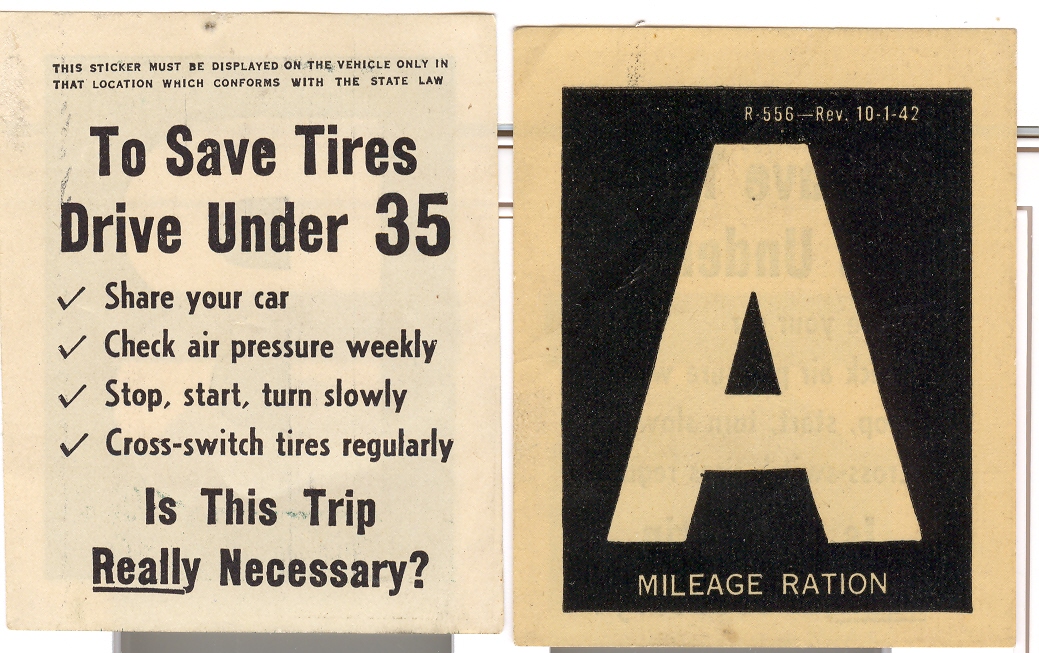
I have several mental pictures of living on the third floor.  I think I can remember one of my first Christmas trees.  That could have been as early as 1941 when I was about 1 ½ years old.  I remember a birthday party, when I was three or four.  There was also a time when my grandmother on Mom’s side came back from a trip to Florida and brought me a tiny catcher’s mitt, which I still have today.  I also remember the day that somebody came to take our 1940 Chevrolet. I asked Dad why and he told me he couldn’t get gasoline and tires for it anymore.  I later learned that we had been able to take a trip to Canada to visit my Mom’s relatives before selling the car.  That was at the time of gasoline rationing and Dad was able to make that long trip by installing an extra gas tank in the trunk and saving up his rationed gasoline.


Gasoline Ration Sticker

Other things I remember about life in East Cleveland during the war include the rationing of food.  I can remember going with Mom to obtain ration stamps and tokens.  She had to get them at Prospect School.  These stamps and tokens were needed to buy certain food such as meat and sugar.  I liked the tokens best.  They were about the size of a dime and some were red and some were blue.


Wartime Travel Permit 1943

I also remember saving metal and grease for the war effort.  We would empty all of our tin cans, take off both ends and step on them to flatten them out.  The ends went inside the flattened can.  That and other metal was picked up by the City in a special truck.  I remember seeing one of our neighbor men working on one of those scrap drive trucks.  When I asked what they were doing, I was told that they were collecting things for the war.  We also saved cooking grease.  We took it to a local mom and pop grocery on Hayden Avenue.  I remember that the owner’s last name was Scher.    Mr. Scher always let me take a cookie from one of the cookie bins.  Needless to say, I always liked going there.  Another use for cooking grease was in making soap.  We sometimes took our grease to my Great Aunt Ethel Dreifort, who made soap and gave us some from time to time.  As I have said before, I never felt deprived as a child.  However, I do remember asking for some things and getting the answer that we can’t get that because there is a war going on.  I guess that seemed to be a reasonable answer at the time. 
My War Ration Book

1945 was a significant year for me.  I had my fifth birthday that year on August 8.  Another thing that happened around my birthday was cause for great celebration.  One day in August we were out in the front yard and I noticed that all the car drivers were blowing their horns and several people stopped to talk to Dad.  Everyone seemed very happy.  I asked Dad what all the excitement was about.  He told me everyone was happy, because the war was over.  That day was Wednesday, August 15, 1945, VJ Day.  To this day I can see that scene in my mind as if it were a movie clip. 


Another event, which made 1945 a special year in my life, was my first day at school.  That September Mom took me to Prospect School, where I enrolled in the afternoon session of kindergarten.  That was my first experience with a group of children with many of whom I was to share the next 13 years of school.  Our teacher was Mrs. Lowry and the classroom was on the first floor overlooking the Euclid Avenue playground.  All I remember about that experience is sitting around in a semicircle and listening to our teacher.  I’m not sure what I was supposed to learn in kindergarten.  The most important life lessons I think I learned included the following: 1. you need permission to go to the bathroom, 2. don’t wait until the last minute to ask.  Most importantly I learned to be self reliant.  After that first day, I walked to and from school by myself.  Even though it was only one block, it involved crossing Euclid Avenue and Shaw Avenue.

East Cleveland Police Officer Jack Baker

Another important event of 1945 was meeting a man, who would be a part of my life for all my years at Prospect.  That man was Officer Jack Baker of the East Cleveland Police Department.  Jack was the school crossing guard at Shaw and Euclid and he helped me and other children safely across that busy intersection for all of those seven years.  Jack always seemed old and fatherly to me.  I’m not sure how old he actually was at that time, but he worked at that intersection until he retired on January 1, 1959.  I have his autograph, which I obtained when I graduated from Prospect in 1952.


 Copyright 2011 Robert C. Dreifort all rights reserved